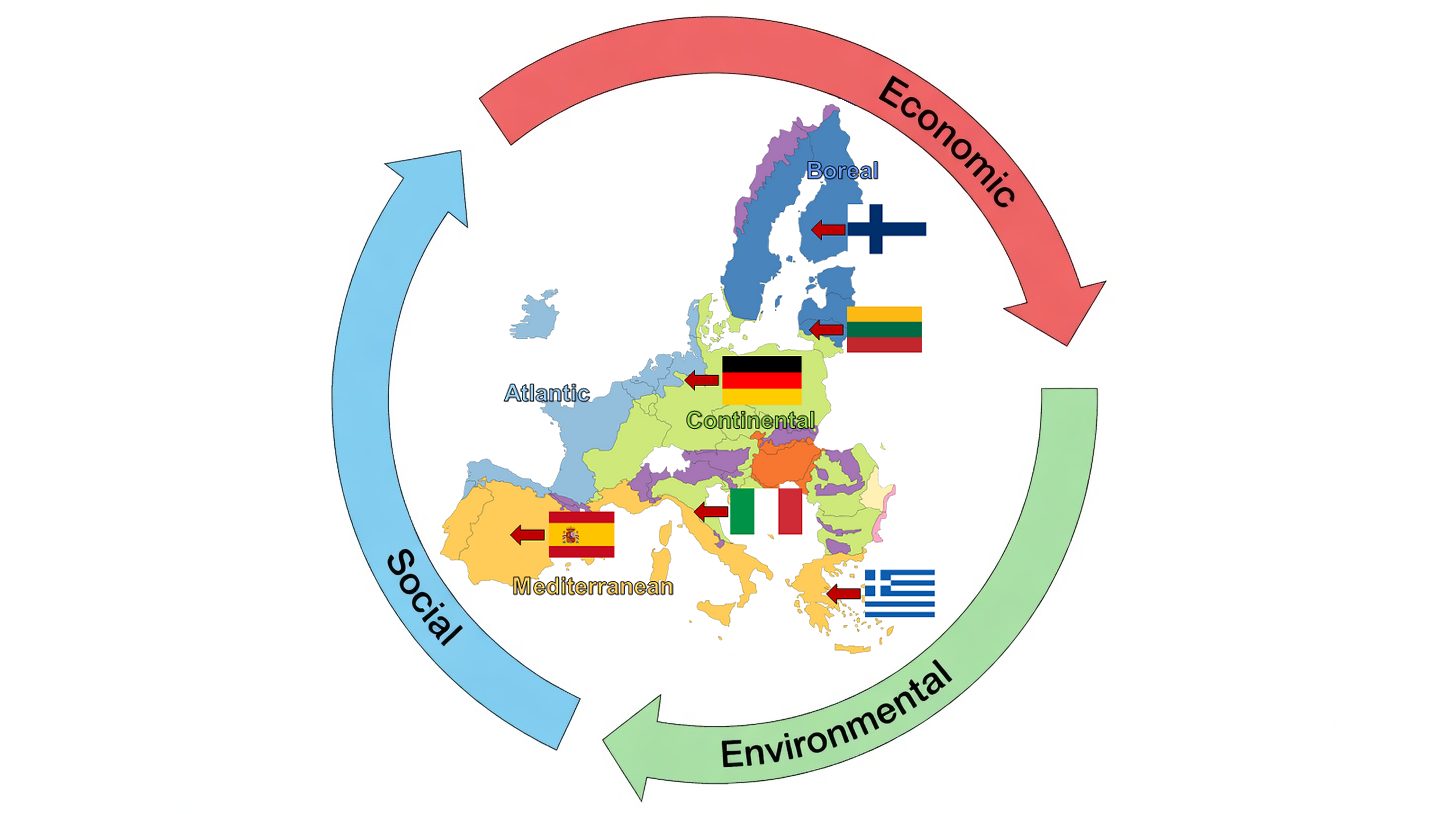
The Work Package 2 (WP2) aims to build a clear, updated, and comparative overview of the development of Nature-based Solutions (NbS) in Europe, analysing how these solutions are applied, transferred, and co-managed in the most advanced contexts. The work is based on a qualified partnership composed mainly of universities, inter-university consortia, and technology parks, distributed across six European countries — Italy, Spain, Greece, Germany, Lithuania, and Finland — selected both for their level of advancement in the sector and for their representativeness of the main European biogeographical regions: Mediterranean, Continental, Atlantic, and Boreal. This configuration ensures outputs that are truly state-of-the-art and representative of the European landscape.
The analysis addresses NbS across the three dimensions of sustainability — environmental, economic, and social — highlighting both the benefits generated, such as enhanced resilience of ecosystems, the creation of green jobs, and improvements in quality of life, as well as the main challenges that still limit their wider adoption. This approach transforms knowledge into an operational tool, enabling stakeholders to understand what works and how it can be adapted and replicated in different contexts.
A distinctive feature of WP2 is its multi-level structure, which develops results through a progressive scaling approach. At the micro level, 16 case study documents, two per partner, are produced using a grounded theory approach, based on direct interviews with exemplary local actors, in order to capture in-depth operational models, success factors, and real implementation dynamics of NbS.
At the meso level, six national reports provide a structured analysis of the sector across the three sustainability dimensions: the environmental dimension, covering climate-related challenges and existing best practices; the economic dimension, examining the actual impact of NbS across primary, secondary, and tertiary sectors; and the social dimension, covering the state of the art in research and development, dedicated policies, education, public awareness, and capacity-building initiatives.
Finally, at the macro level, all data are integrated into a European comparative report, which applies a clustering approach to identify transnational connections between challenges and best practices, in light of the four European biogeographical regions and the three dimensions of sustainable development.
WP2 is designed to directly support VET teachers and trainers, providing concrete references to integrate NbS into educational pathways, while also raising awareness among students, young people, and citizens about their potential in terms of sustainable employment, social innovation, and climate adaptation. In this way, the Work Package contributes to building a solid foundation for the development of competences aligned with the green transition.
Through this work, WP2 transforms data and analysis into accessible and actionable knowledge, creating a shared reference framework for the project and contributing to guiding education, policies, and the development of Nature-based Solutions across Europe.